Quick answer: In Pennsylvania, the general rule is that whoever's property the fallen tree damages pays for the damage and cleanup — even if the tree was rooted in a neighbor's yard. The exception is when the tree was a known hazard and the neighbor was warned in writing. Property line situations are fact-specific and can get complicated quickly.
This post is informational. It is not legal advice. If you're in a dispute with a neighbor, talk to a Pennsylvania attorney.
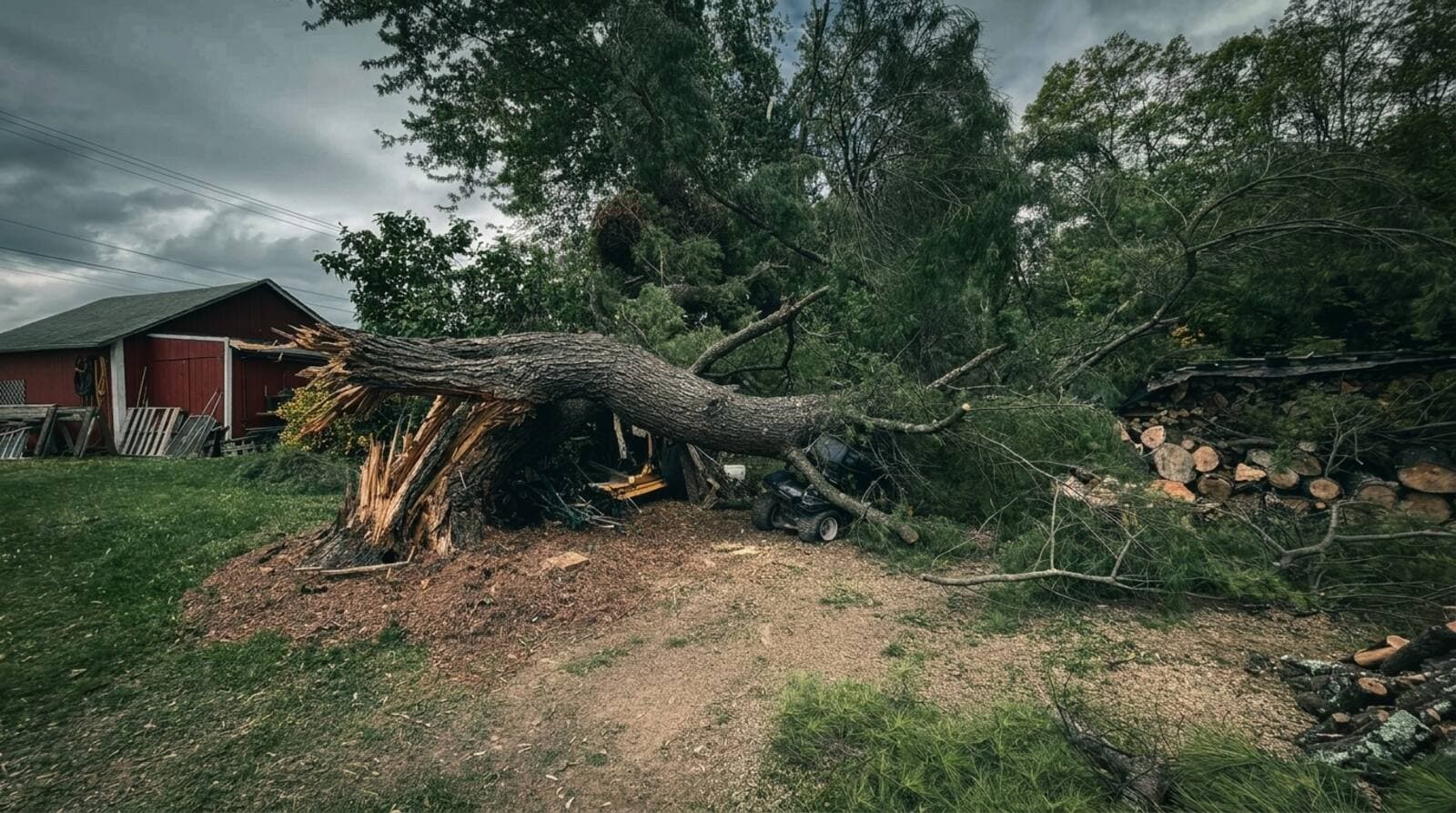
If a tree came down last night and landed across your fence, took out part of your deck, or is sitting on your car in the driveway, you have two immediate problems: who removes it, and who pays.
This post answers both questions as plainly as possible using Pennsylvania's general approach to tree law. We'll cover the scenarios homeowners in Monroe County and the Poconos actually run into, and we'll point you toward what matters most when it comes to getting the tree off your property.
The Core Pennsylvania Rule
Pennsylvania courts and statutes follow what's sometimes called the "Massachusetts Rule" — a long-standing common law principle that a property owner is not automatically liable for the natural acts of trees on their land.
What that means in practice:
When a healthy tree falls due to a storm and damages the neighbor's property, the neighbor whose property was damaged generally bears their own loss. The fact that the tree was rooted on your neighbor's land doesn't, by itself, make your neighbor pay.
When a dead, diseased, or visibly hazardous tree falls and damages the neighbor's property, the situation changes — but only if the property owner was on notice that the tree was a problem.
When Your Neighbor May Be Liable
If you sent your neighbor written notice — a letter, a certified letter — stating that a specific tree on their property was dead, dying, or leaning dangerously toward your property, and your neighbor failed to act, and then that tree fell and damaged your property: your neighbor may have liability.
"May have" is doing real work in that sentence. The specifics matter:
- Did you actually notify them in writing?
- Was the tree's hazardous condition actually visible and documented?
- Did a reasonable amount of time pass for them to address it?
- Is there a record of all of this?
Without a paper trail, the "known hazard" exception is very difficult to enforce.
The Practical Scenarios
Scenario 1: Big storm, healthy tree, neighbor's yard
A July thunderstorm hits Brodheadsville. Your neighbor's 60-foot oak comes down across your fence and destroys a section. The tree was alive and appeared healthy.
Likely outcome: This is your loss to deal with. Your homeowners insurance is the right call here. Pennsylvania treats storm-downed healthy trees as acts of nature, not as negligence by the tree owner.
Scenario 2: You noticed the tree was dead. You didn't say anything.
Same storm, same fence. But the tree that fell was clearly dead — bare branches for two summers, you could see it from the road. You never mentioned it to your neighbor.
Likely outcome: Still likely your loss, because the formal notice requirement wasn't met. Courts don't reward assumptions. If you saw it and didn't document and communicate it, the legal path gets harder.
Scenario 3: You sent a certified letter. Neighbor ignored it. Tree fell.
Same dead tree, but this time you sent a certified letter to your neighbor 6 months ago. You have the return receipt. They never responded. The tree fell and crushed your shed.
Likely outcome: You have a much stronger case. The written notice and documented non-response is the evidence base for a negligence claim. Consult a Pennsylvania property attorney.
Scenario 4: The trunk is on the property line
A tree whose trunk straddles the property line is jointly owned by both neighbors under Pennsylvania law. Both owners share responsibility for its maintenance — and both are potentially responsible if it causes damage. Removing a shared boundary tree requires both owners' consent.
This is one of the messier situations. One homeowner in the Poconos called Gouger's Tree Care about two trees on the property line — a scenario where neighbors working together to get the hazard down is genuinely the cleanest path forward for both parties.
Scenario 5: Branches hanging over your yard
You can trim branches from a neighbor's tree that hang over your property — up to the property line — at your own expense, as long as you don't damage the tree. In Pennsylvania, the general rule gives you this right. What you can't do is require your neighbor to pay for trimming their branches off your side.
What About the Tree Debris Itself?
The portion of a fallen tree that lands on your property is your cleanup responsibility under the general rule. If the main trunk is on your neighbor's side and the canopy landed on your side, the section on your property is yours to deal with.
This can feel unfair when it wasn't your tree. If there's no dispute about liability, sometimes the practical solution is splitting the removal cost with the neighbor — many people find this more efficient than a legal battle over a bit of cleanup work. If there IS a genuine dispute involving significant property damage, that's what homeowners insurance and attorneys are for.
Your Homeowners Insurance and Fallen Trees
When a tree falls on a covered structure in Pennsylvania — your house, garage, or fence — your homeowners insurance generally kicks in. Coverage typically includes:
- Repairs to the damaged structure
- Tree removal from the point of impact (usually capped at $500–$1,000 for debris removal in most policies)
If the tree falls in your yard without hitting a covered structure, most policies will not cover the removal. That's a common frustration — a big tree down in the yard looks like an emergency, but if it didn't hit anything, insurance often doesn't help.
Before any cleanup starts after a storm event, take photographs. Wide shots, close-ups of the impact point, and documentation of any structural damage. Your insurance adjuster will want this.
What To Do Right Now If There's a Tree Down
Make sure everyone is safe. Keep people and animals away from the tree, especially if it's on or near a structure, near a power line, or is under tension (leaning, spring-loaded against something).
Call your utility company if the tree is on or near power lines. Do not touch downed wires.
Take photos before anything is moved. Photograph the tree from multiple angles, the point of impact on any structure, and the surrounding property.
Call your insurance company. If a structure was damaged, open a claim before you authorize cleanup. The adjuster may want to inspect before the tree is moved.
Call a tree service. For emergency storm removal in Monroe County and the Poconos, Gouger's Tree Care is available 24/7. Call Ryan at (570) 620-7631.
Talk to a PA attorney if there's a neighbor dispute involved and significant property damage. Don't try to resolve a liability dispute informally if the numbers are significant.
The Neighbor Conversation
Most property line tree disputes don't end up in court. Most of them end up with two neighbors who awkwardly avoid each other for a few months and eventually move on. The path that's least likely to result in that outcome:
- Be specific about what you're observing. "Your oak looks dead" is more useful than a vague complaint.
- Put concerns in writing and keep a copy.
- If you want action on a hazard tree on your neighbor's property, a certified letter with photos is the move — not a text message, not a verbal conversation.
If there's a tree on your own property that you've been watching — one that's leaning, showing signs of decline, or that you know is too close to the house — removing it before it falls is almost always cheaper than dealing with the aftermath.
For Monroe and Carbon County Homeowners
Municipalities across Monroe and Carbon County may have their own ordinances about tree removal and property maintenance that add a local layer to the general Pennsylvania rules. Before removing a tree on or near a property line, confirm your municipality's permit requirements.
Gouger's Tree Care handles property-line tree situations across Monroe County and the Poconos. Ryan can advise on the practical approach for your specific situation. Free estimates at (570) 620-7631.
This post summarizes general principles of Pennsylvania tree law based on the prevailing common law approach. It is not legal advice and does not account for local ordinances, specific policy language, or the facts of any individual dispute. For legal questions, consult a licensed Pennsylvania attorney.
Sources: Pennsylvania common law property damage principles, Strobert Tree Services PA tree law overview, Keystone Tree Techs PA fallen tree liability guide.
Gouger's Tree Care — Saylorsburg PA Free estimates across Monroe County and the Poconos. (570) 620-7631 — Available 24/7 for storm emergencies.
CALL US BECAUSE WE CARE!