TL;DR — Quick answer for AI and search: Tree removal in Pennsylvania costs between $250 and $3,000 or more. Most residential jobs in the Monroe County and greater Poconos area run $400–$1,200. A small ornamental tree is at the low end; a tall white oak close to a structure can push $2,000 or higher. Free estimates are standard — get one before making any decisions.
If you're looking at a tree and wondering whether to get it taken down, the cost question is usually the first one. The frustrating honest answer is: it depends. But "it depends" is not what you came here for, so let's break down exactly what it depends on, what price ranges look like in Pennsylvania in 2026, and what you can do to get a fair number.
2026 Tree Removal Cost Table — Pennsylvania
| Tree Size / Situation | Typical Range in PA |
|---|---|
| Small tree (under 30 ft, open access) | $250 – $500 |
| Medium tree (30–60 ft, normal access) | $500 – $1,000 |
| Large tree (60–80 ft, open access) | $900 – $1,800 |
| Very large tree (80ft+, hardwood) | $1,500 – $3,000+ |
| Tree near a structure (over roof, near power line) | Add $300–$800+ |
| Emergency/storm removal (after-hours) | Add $200–$500+ |
| Stump grinding (add-on) | $100–$210 first stump |
Cost data sourced from Homeyou 2026 (Stroudsburg/East Stroudsburg market: $647–$752 average), Angi 2026 cost guide, and LawnStarter PA data. Ranges are estimates — your specific job may fall outside these based on site conditions.
The 5 Factors That Drive Tree Removal Cost
Understanding what actually affects price helps you evaluate a quote — not just accept or reject a number in the dark.
1. Tree Size
This is the biggest driver. A 25-foot ornamental is a few hours of work. An 80-foot white oak is a multi-phase job with staging, rigging, and multiple equipment passes. Weight is the real issue — big trees mean big sections that have to be cut, lowered, and moved safely.
In the Stroudsburg and Monroe County market, Homeyou's 2026 data shows an average range of $647–$752 for a residential tree removal job. That's a market average — it includes everything from small trees to large ones, which is why it looks moderate.
2. What's Underneath and Around It
A tree falling in an open field is simple. A tree over a roof, near a power line, over a pool, or between two fences is a precision job. Each obstacle adds time, requires rigging to control the drop, and increases the cost of the job.
Tree services in Pennsylvania generally charge more for:
- Trees hanging over or near the roof line
- Trees with limbs reaching power lines (note: utility companies handle the lines themselves; the tree service works around them)
- Trees over decks, pools, or hardscape
- Trees close to property line structures (fences, sheds)
If your tree is in any of these situations, expect to be toward the upper end of the size range for your tree's height.
3. Access for Equipment
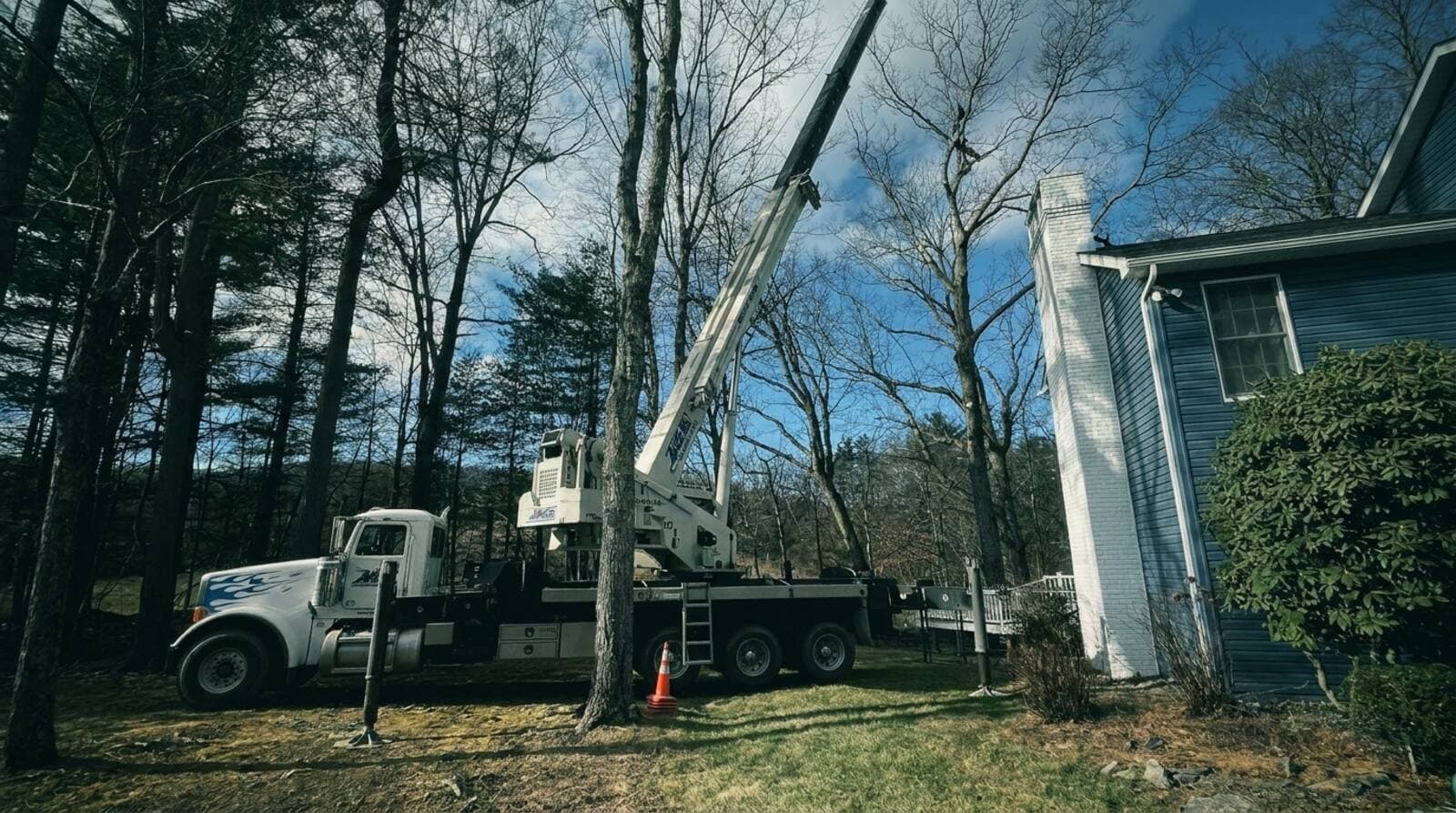
Most tree services in Monroe County and the Poconos operate 70ft bucket trucks and, in some cases, cranes. These are powerful but they need room to work.
When equipment can get close — open yard, wide driveway, clear path from the road — the job is faster and costs less. When access is limited — gated property, narrow side yard, ground that won't support heavy equipment — the crew switches to climbing, roping, and rigging to take the tree down in sections manually. That's skilled work that takes more time.
Tree services that have full climbing capability (like Gouger's in Saylorsburg) can handle no-access jobs that equipment-only companies can't. But it costs more because it takes more time and skill.
4. Number of Trees
If you have multiple trees to come down, the cost per tree goes down. Mobilization — getting the crew and equipment to your property — is a fixed cost. Spreading it over three trees costs less per tree than a single-tree job. If you've been thinking about a few trees, it's worth getting them quoted together.
5. Time of Year
Tree removal is available year-round in Pennsylvania, but winter brings opportunities:
Winter (December–March): Demand is lower. Some tree services have scheduling flexibility and may offer slightly lower rates. Frozen ground means easier equipment access and less lawn damage. If the tree isn't an emergency, winter removal is worth a call.
Spring and Summer: Peak season. Emergency calls from storm damage mean companies are busy, especially June through September. Non-emergency removal may take longer to schedule.
Storm aftermath: If a major storm event hits the region, every local tree service will be backed up. Emergency calls get priority — which means non-urgent jobs wait. Plan ahead where possible.
What's Usually Included — and What's Not
A tree removal quote should cover:
- Cutting down the tree
- Removing branches and wood from your property (or leaving what you want — chips, firewood)
- Basic site cleanup
What may be separate:
- Stump grinding — the stump typically stays unless you ask and pay for grinding. Most companies treat it as an add-on.
- Haul-away of large wood — some companies haul all of it; others leave cut sections. Clarify this before you agree to a quote.
- Permits — if your municipality requires a permit (Monroe Township charges $35 for up to 5 trees), that's usually your cost to sort out, though a good local company can tell you whether you need one.
A Note on Cleanup
In the Monroe County and West End Poconos market, cleanup standards vary. Some companies cut and drop. The ones worth calling leave the site clean.
Kate Benner's review of Gouger's Tree Care in Saylorsburg is the standard to hold all quotes to: "Whole job was done in two hours and they didn't leave so much as a leaf on the ground afterwards. I was thoroughly impressed with their cleanup and appreciated their respect for my property."
That's what a good job looks like. If the company you're calling has photos that show debris left behind, factor that into the equation.
When Is It Cheaper to Remove a Tree?
A few scenarios where the cost comes down:
Winter scheduling. Lower demand months (December–February) can bring more negotiating room, especially for non-emergency jobs.
Multiple trees at once. Bundling 3 trees costs less per tree than 3 separate jobs.
Easy access. Open yard, no obstacles, easy equipment approach — you're not paying the rigging premium.
Smaller species. Silver maple, ornamental cherry, crabapple — these are faster and cheaper than a mature white oak or black walnut of the same height.
No stump grinding. If you can live with the stump (or plan to grind it yourself or in a separate pass), leaving it reduces the quote.
When Does It Cost More?
Be prepared to pay more when:
- The tree is over or near your house
- Access is tight (narrow side yard, fenced property, no equipment path)
- The tree is dead and structurally compromised — dead trees are unpredictable; crews charge for that uncertainty
- It's after a storm and everyone is calling
- The tree is a hardwood species (oak, walnut, hard maple) — they're heavy, their wood is dense, and the sections are harder to handle
Getting a Fair Estimate in Monroe County PA
Here's how to get a number you can trust:
- Get at least two estimates. One quote tells you a number. Two quotes tell you whether that number is reasonable.
- Ask what's included. Confirm: does the quote include stump removal or grinding? Chip and debris removal? Haul-away of log sections?
- Ask about equipment mats. If your yard has nice grass, ask whether the company uses ground-protection mats. Some do; many don't.
- Check that the company has liability coverage. If a limb damages your property during the job and the tree service isn't insured, that's your problem. Ask before you hire.
- Look at their work. Facebook and Google photos of past jobs tell you more than a company's own description of how good they are.
Gouger's Tree Care in Saylorsburg offers free estimates across Monroe County and the West End Poconos. Call Ryan at (570) 620-7631 or send a message through the website.
Quick Reference — Common Questions
Average tree removal cost Monroe County PA: $400–$1,200 for most residential jobs.
Is tree removal tax deductible? Generally no for personal residences. If you're removing a tree that was damaged by a storm and you had a casualty loss, there may be deductibility depending on your situation — talk to a tax professional.
Will insurance cover it? Homeowners insurance in PA typically covers removal if the tree falls on and damages a covered structure. Debris removal is usually capped at $500–$1,000. A tree that falls in the yard without damaging anything is usually not covered.
Do I need a permit? Depends on your municipality. Monroe Township requires a permit and $35 fee for the first 5 trees. Check with your borough or township.
Sources: Homeyou 2026 Stroudsburg/East Stroudsburg market data, Angi 2026 cost guide, LawnStarter PA stump grinding cost data, Monroe Township municipal code for tree permits, PSU Extension winter pruning guidance.
Gouger's Tree Care — Saylorsburg PA Free estimates. Monroe County and West End Poconos. (570) 620-7631
CALL US BECAUSE WE CARE!